ABOVE;DR: Convert Markdown to PDF in C# using the .NET Word Library with just a few lines of code. Install the NuGet package, add the namespace, and run the conversion. Customize images to events, embed diagrams, or handle base64 streams. Ideal for documentation, eBooks, reports and compliance workflows. Fast, accurate, and scalable for developer productivity.
Markdown is loved by developers, but PDF is trusted by everyone
Markdown is a popular choice for developers creating documentation and technical content. But when it comes to sharing or archiving, PDF is the format of choice because of its consistency and professionalism.
In this blog, you will learn how to convert Markdown to PDF using C# And Synchronization® .NET Word Library with practical code examples, real-world use cases, and advanced customization tips.
Explore Now
Why convert Markdown to PDF?
Markdown is ideal for:
- Write clean, easy-to-read documentation.
- Create light technical content.
- Collaborate in a version-controlled environment.
PDF is better for:
- Print and share with non-technical users.
- Preserves formatting across devices.
- Filing and compliance.
Combining these formats gives you developer-friendly writing and professional-grade results. Next, let’s take a look at what you’ll need before starting the conversion process.
Prerequisite
- .NET project (console application, service, or web application).
- Markdown file (eg: Input.md).
- DocIO Sync Package.
How to convert Markdown to PDF in C# using .NET Word Library
Follow these steps to convert Markdown files to PDF in C# using Syncfusion .NET Word Library:
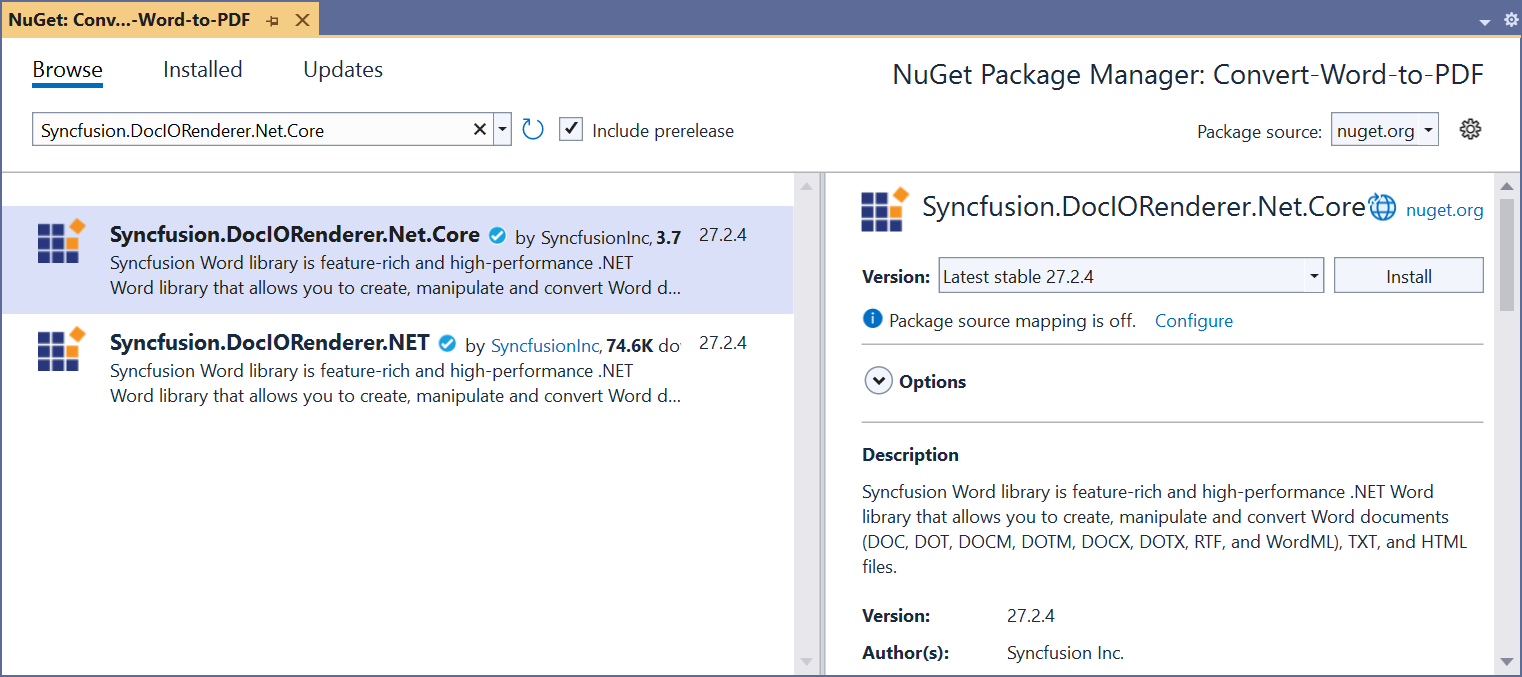
Step 1: Install the Syncfusion DocIO NuGet package
First, add the NuGet package Syncfusion.DocIORenderer.Net.Core to your project, as shown below.
Step 2: Add the required namespace
Next, add the following namespace to your file:
using Syncfusion.DocIO;
using Syncfusion.DocIO.DLS;
using Syncfusion.DocIORenderer;
using Syncfusion.Pdf;
Step 3: Convert Markdown to PDF using C#
Open the markdown flow in Word, then save it as a PDF.
Here’s the code you’ll need:
// Open the Word document file stream.
using (FileStream inputStream = new FileStream("Template.md", FileMode.Open, FileAccess.ReadWrite))
{
    // Load an existing Word document.
    using (WordDocument wordDocument = new WordDocument(inputStream, FormatType.Markdown))
    {
        // Create an instance of DocIORenderer.
        using (DocIORenderer renderer = new DocIORenderer())
        {
            // Convert Word document into PDF document.
            using (PdfDocument pdfDocument = renderer.ConvertToPDF(wordDocument))
            {
                // Save the PDF file to the file system.
                using (FileStream outputStream = new FileStream("Output.pdf", FileMode.Create, FileAccess.ReadWrite))
                {
                    pdfDocument.Save(outputStream);
                }
            }
        }
    }
}
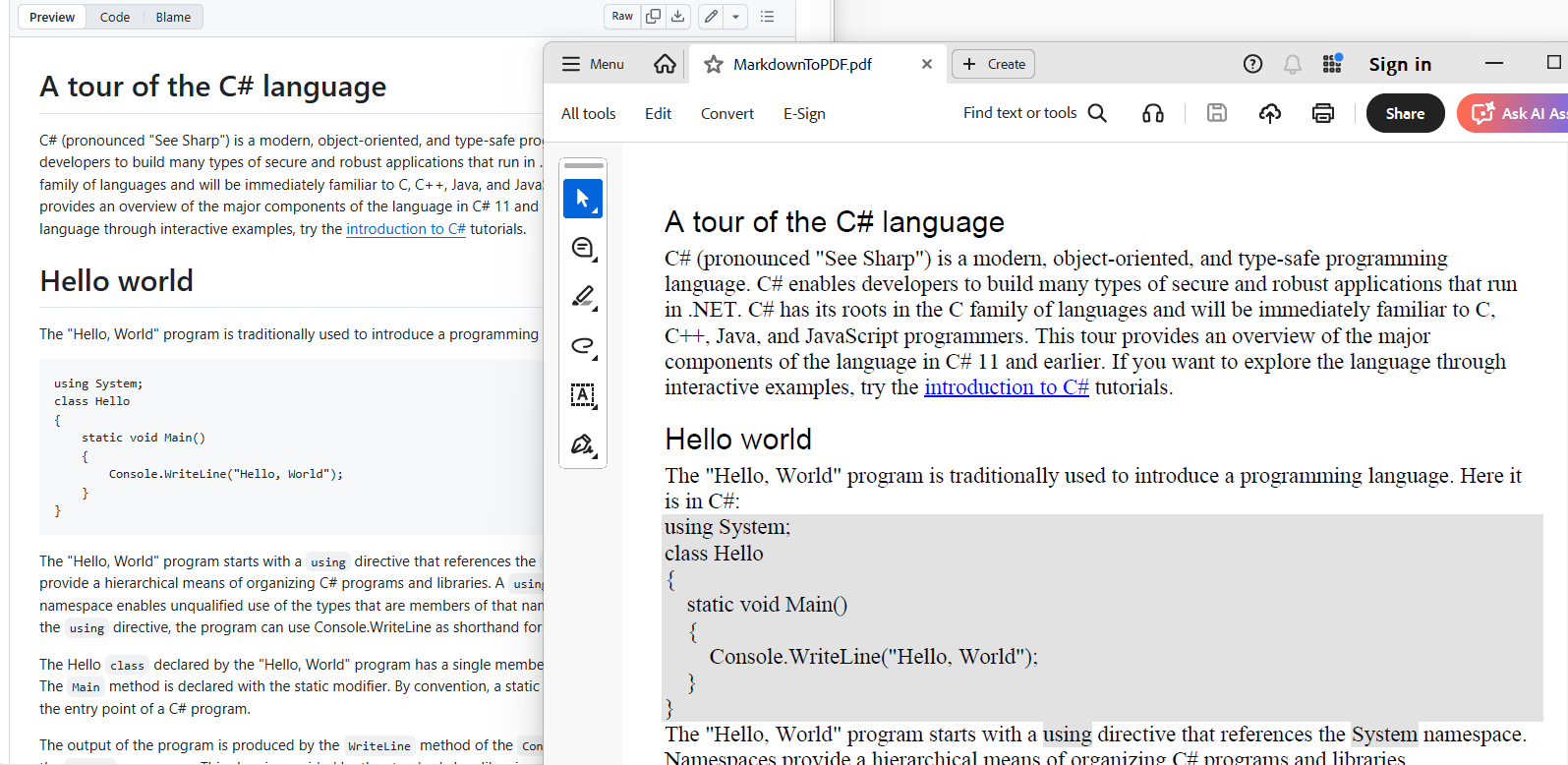
By executing this code example, we will get the output as in the following image.

Read Now
Advanced image adjustment options
When converting Markdown to PDF using the .NET Word Library, we have the flexibility to modify the images included in the input Markdown file.
Hook the ImageNodeVisited event
We can download the image listed as a URL in the Markdown file and insert it into the resulting Word document.
You can:
- Replace placeholder images with client-specific branding.
- Embed diagrams from a URL or local folder.
- Handles base64 encoded images.
- Adjust the image flow using
ImageNodeVisitedincident.
See the following code example to achieve this.
// Open a file as a stream.
using (FileStream fileStreamPath = new FileStream("Input.md", FileMode.Open, FileAccess.Read, FileShare.ReadWrite))
{
    // Create a Word document instance.
    using (WordDocument document = new WordDocument())
    {
        // Hook the event to customize the image while importing Markdown.
        document.MdImportSettings.ImageNodeVisited += MdImportSettings_ImageNodeVisited;

        // Open an existing Markdown file.
        document.Open(fileStreamPath, FormatType.Markdown);

        // Create an instance of DocIORenderer.
        using (DocIORenderer renderer = new DocIORenderer())
        {
            // Convert Word document into PDF document.
            using (PdfDocument pdfDocument = renderer.ConvertToPDF(document))
            {
                // Save the PDF file to the file system.
                using (FileStream outputStream = new FileStream("Output.pdf", FileMode.Create, FileAccess.ReadWrite))
                {
                    pdfDocument.Save(outputStream);
                }
            }
        }
    }
}
What changed: Now, whenever DocIO finds an image in Markdown, it will call your handler and give you the opportunity to provide the actual image stream.
Try Now
Implement an image handler
The following C# code illustrates the use of an event handler to customize an image based on the source path.
private static void MdImportSettings_ImageNodeVisited(
    object sender,
    Syncfusion.Office.Markdown.MdImageNodeVisitedEventArgs args)
{
    // Retrieve the image from the local machine file path and use it.
    if (args.Uri == "Road-550.png")
    {
        args.ImageStream = new FileStream(args.Uri, FileMode.Open);
    }
    // Retrieve the image from the website and use it.
    else if (args.Uri.StartsWith("
    {
        using WebClient client = new WebClient();
        // Download the image as a stream.
        byte[] image = client.DownloadData(args.Uri);
        Stream stream = new MemoryStream(image);
        // Set the retrieved image from the input Markdown.
        args.ImageStream = stream;
    }
    // Retrieve the image from the Base64 string and use it.
    else if (args.Uri.StartsWith("data:image/"))
    {
        string src = args.Uri;
        int startIndex = src.IndexOf(",");
        src = src.Substring(startIndex + 1);

        byte[] image = Convert.FromBase64String(src);
        Stream stream = new MemoryStream(image);
        // Set the retrieved image from the input Markdown.
        args.ImageStream = stream;
    }
}
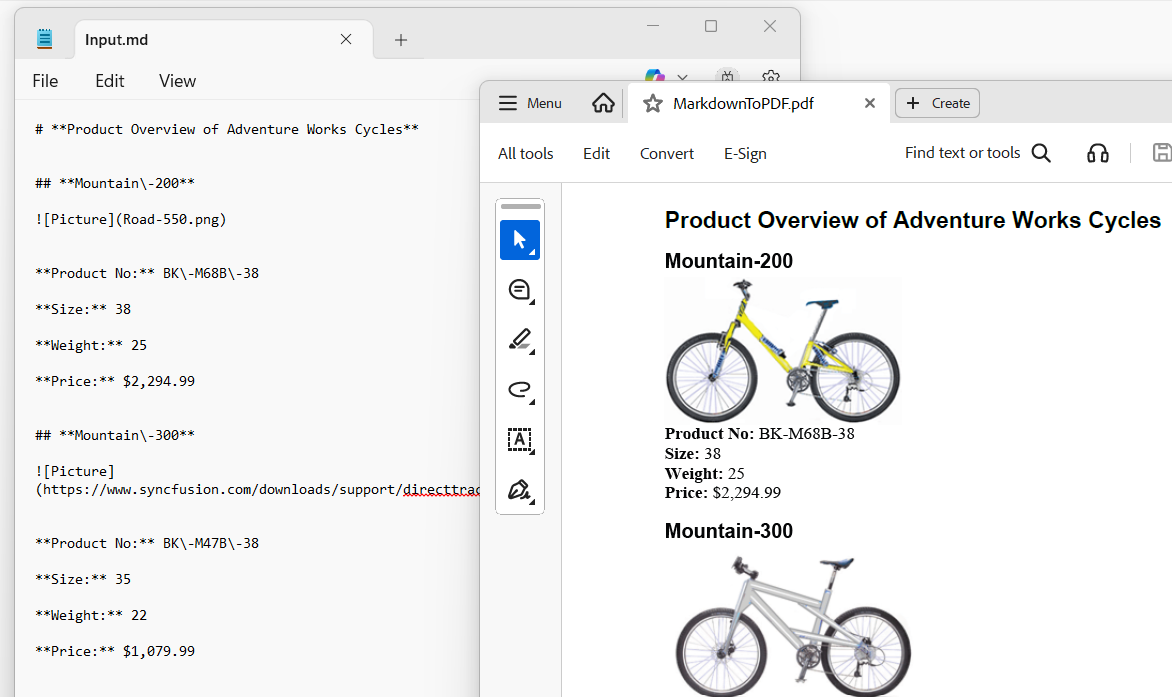
By running this code example, you will get the output as shown below.
Real world use cases
This isn’t just a demo feature; it is widely used in production:
- e-book publishing: Convert Markdown manuscripts into professionally formatted PDF eBooks.
- Scientific papers: Prepare written research papers at markdown for journal submission or peer review.
- Blog to PDF: Create downloadable versions of blog posts for newsletters or offline reading.
- Technical documentation: Convert README files or API documents into shareable and printable PDFs.
- Corporate reporting: Produce formal internal reports from markdown guidelines for compliance or presentation.
- Legal and policy documents: Export markdown-based contracts or policies into standard PDF format.
- Software release notes: Share version updates and change logs in PDF format for internal or customer use.
GitHub Reference
You can also find ready-to-run code examples for converting Markdown to PDF in C# using the Syncfusion .NET Word Library in our GitHub repository.
Frequently Asked Questions
Which Markdown syntax elements are supported when importing a Markdown file into a Word document using the Syncfusion word library?
The Syncfusion Word library largely follows suit CommonMark GitHub flavor specifications and syntax. To find out more about supported syntax, see this documentation.
Does markdown to PDF conversion work on Linux or macOS with .NET Core?
Yes. The Syncfusion .NET Word library supports Markdown-to-PDF conversion in active .NET Core applications Linux and macOS.
Is it possible to convert Markdown to Word/HTML?
Yes, markdown files can be converted to Word/HTML using the Syncfusion .NET Word library. To find out more about conversions, check out this documentation.
Try it Free
Start turning your Markdown into professional PDFs today
Thanks for reading! Converting Markdown to PDF in C# is easy with the right tools. Whether you’re creating a documentation generator or a content publishing tool, this approach is efficient and scalable. By following the example above, you can integrate C# Markdown-to-PDF conversion into your application easily and flexibly.
For more details, check out our official guide.
Bonus: What else can the .NET Word Library do?
Apart from this conversion function, our Syncfusion .NET Word Library has the following important functions:
- Create, read, and edit Word documents programmatically.
- Create complex reports by combining data into Word templates from multiple data sources via mail merge.
- Merge, split, and organize Word documents.
- Convert Word documents to PDF, HTML, RTF, images and other formats.
You can find more examples of Word Libraries at this GitHub location.
Are you already a Syncfusion user? You can download the product setup from our licensing and downloads page. If you’re not yet a Syncfusion user, you can download a 30-day trial.
If you have any questions, contact us via our support forum, support portal, or feedback portal. We are always happy to help you!
PakarPBN
A Private Blog Network (PBN) is a collection of websites that are controlled by a single individual or organization and used primarily to build backlinks to a “money site” in order to influence its ranking in search engines such as Google. The core idea behind a PBN is based on the importance of backlinks in Google’s ranking algorithm. Since Google views backlinks as signals of authority and trust, some website owners attempt to artificially create these signals through a controlled network of sites.
In a typical PBN setup, the owner acquires expired or aged domains that already have existing authority, backlinks, and history. These domains are rebuilt with new content and hosted separately, often using different IP addresses, hosting providers, themes, and ownership details to make them appear unrelated. Within the content published on these sites, links are strategically placed that point to the main website the owner wants to rank higher. By doing this, the owner attempts to pass link equity (also known as “link juice”) from the PBN sites to the target website.
The purpose of a PBN is to give the impression that the target website is naturally earning links from multiple independent sources. If done effectively, this can temporarily improve keyword rankings, increase organic visibility, and drive more traffic from search results.
